


1000W-3000W SMPS
Overview
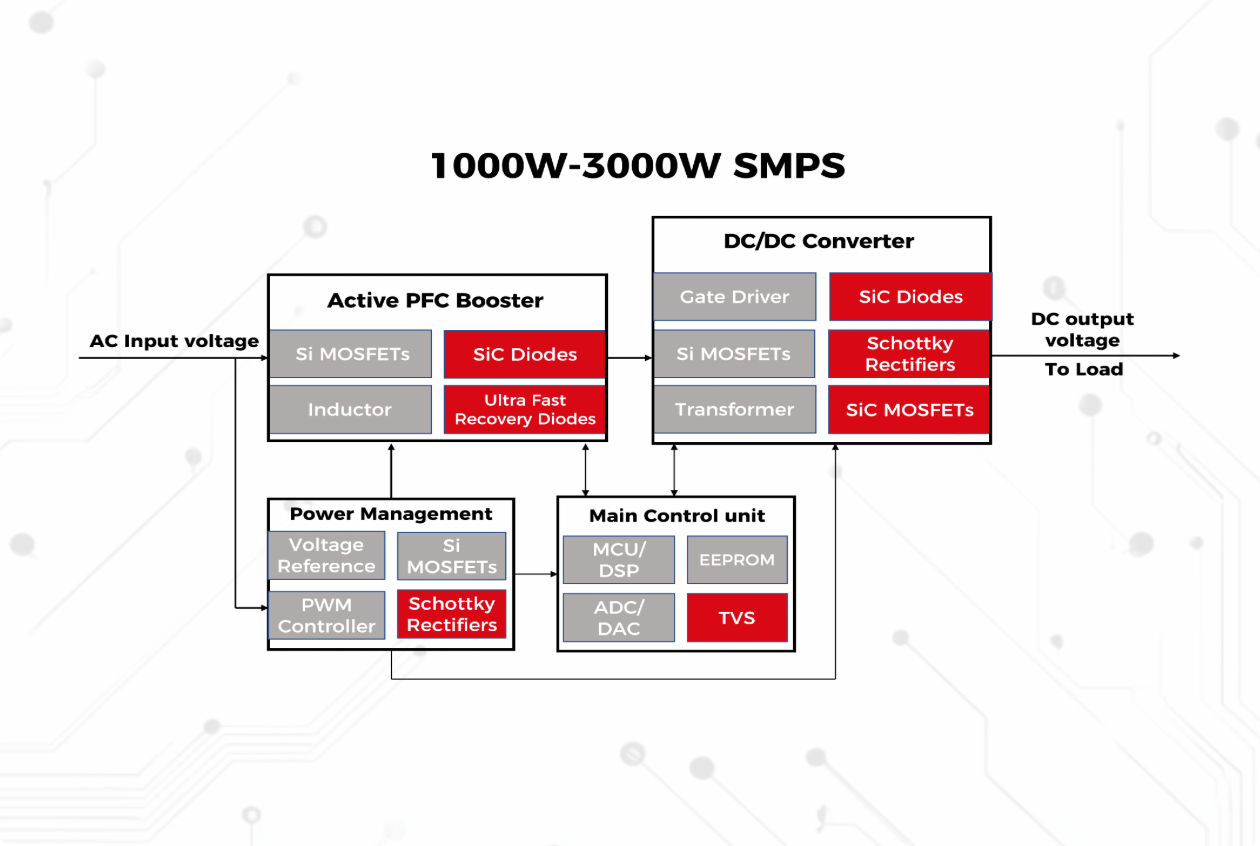
With the rapid development of industrial automation, data centers, and renewable energy sectors, 1000W-3000W medium-to-high-power switched-mode power supplies (SMPS) have become mainstream due to their high efficiency, power density, and stability. These power supplies typically adopt a two-stage design: a front-stage Power Factor Correction (PFC) circuit followed by a DC/DC converter. Working synergistically, they achieve wide input voltage range, low harmonic distortion, and high-efficiency output. This article systematically analyzes their operating principles, typical topological architectures, and explores industry development trends.
Operating Principles
PFC Stage Operation
The core function of the PFC circuit is to force the input current waveform to track the input voltage waveform, achieving a power factor close to unity. For power levels above 1000W, Interleaved Boost Topology is commonly employed:
- Input Rectification & Filtering: AC input is converted to pulsating DC through a rectifier bridge and EMI filter.
- Boost Conversion: Voltage boosting is achieved through PWM modulation of MOSFETs, where inductor energy storage and release stabilizes the output voltage at 380-400V DC.
- Interleaving Technique: Two or more phases operate in parallel to reduce current stress and enhance efficiency (>95%).
DC/DC Stage Operation
The downstream DC/DC converter regulates the output voltage according to load requirements. Common solutions include:
- LLC Resonant Converter: Utilizes a resonant tank (resonant inductor Lr, resonant capacitor Cr, and transformer magnetizing inductor Lm) to achieve soft switching (ZVS/ZCS), minimizing switching losses. Ideal for constant voltage outputs.
- Phase-Shifted Full-Bridge (PSFB): Leverages transformer leakage inductance and external capacitors for Zero-Voltage Switching (ZVS), suitable for high-current outputs.
Topological Architecture Analysis
PFC Stage Topologies
- Continuous Conduction Mode (CCM) Boost: Suitable for full power range but requires handling reverse recovery issues.
- Totem-Pole Bridgeless PFC: Eliminates the rectifier bridge, improving efficiency by 1-2%, but demands higher MOSFET voltage ratings.
DC/DC Stage Topologies
- LLC Resonant Converter: Advantages include high-frequency operation (>100kHz) and low EMI, albeit with slower dynamic response.
- Two-Transistor Forward/Flyback Combination: Lower cost but limited power density, often used below 1500W.
Market Prospects & Development Trends
Key Drivers
- Data Center Demand: 5G and AI drive hyperscale data center construction, demanding ultra-high-efficiency power supplies (Titanium-level).
- Renewable Energy Applications: Surging requirements for 3000W modules in PV inverters and energy storage systems (ESS).
- Regulatory Policies: Stricter global harmonic standards (e.g., IEC 61000-3-2) compel technological upgrades.
Technology Trends
- Wide-Bandgap Semiconductor Adoption: SiC/GaN devices enable higher frequencies (MHz range), reducing thermal management costs.
- Digital Control: DSPs replacing analog ICs enable adaptive loop tuning and predictive maintenance.
- Modular Design: Supports N+1 redundancy, meeting critical reliability needs in server power systems.
Challenges
- Thermal Management: Increasing difficulty in thermal design under high power density necessitates liquid cooling or phase-change materials.
- Cost Pressure: High prices of SiC devices remain a barrier; industry-wide cost reduction efforts are essential.
Conclusion
The two-stage PFC + DC/DC architecture in 1000W-3000W SMPS achieves an optimal balance of high efficiency and reliability. Driven by digitalization, wide-bandgap semiconductors, and topological innovations, future development will focus on higher power density (>50W/in³) and enhanced intelligence. Manufacturers must prioritize domestic core component development and system integration capabilities to capitalize on emerging opportunities in renewable energy and the digital economy.
The advantages of SMC
SMC, as a globally leading power semiconductor device manufacturer with nearly 30 years of history, can provide customers with the most advanced, efficient, and cost-effective third-generation silicon carbide MOSFETs and silicon carbide JBS diodes. In addition, SMC has unique experience in silicon-based power diode devices, and its best-selling high-power ultra-fast recovery diodes, high current Schottky diodes, and other products are highly praised by customers worldwide. SMC's power semiconductor devices can provide higher efficiency, better reliability, good delivery time, and competitive prices for your products. SMC's professional service team around the world allows you to experience the ultimate customer service experience and safeguard your product design.


 点击获赠免费样品!


